
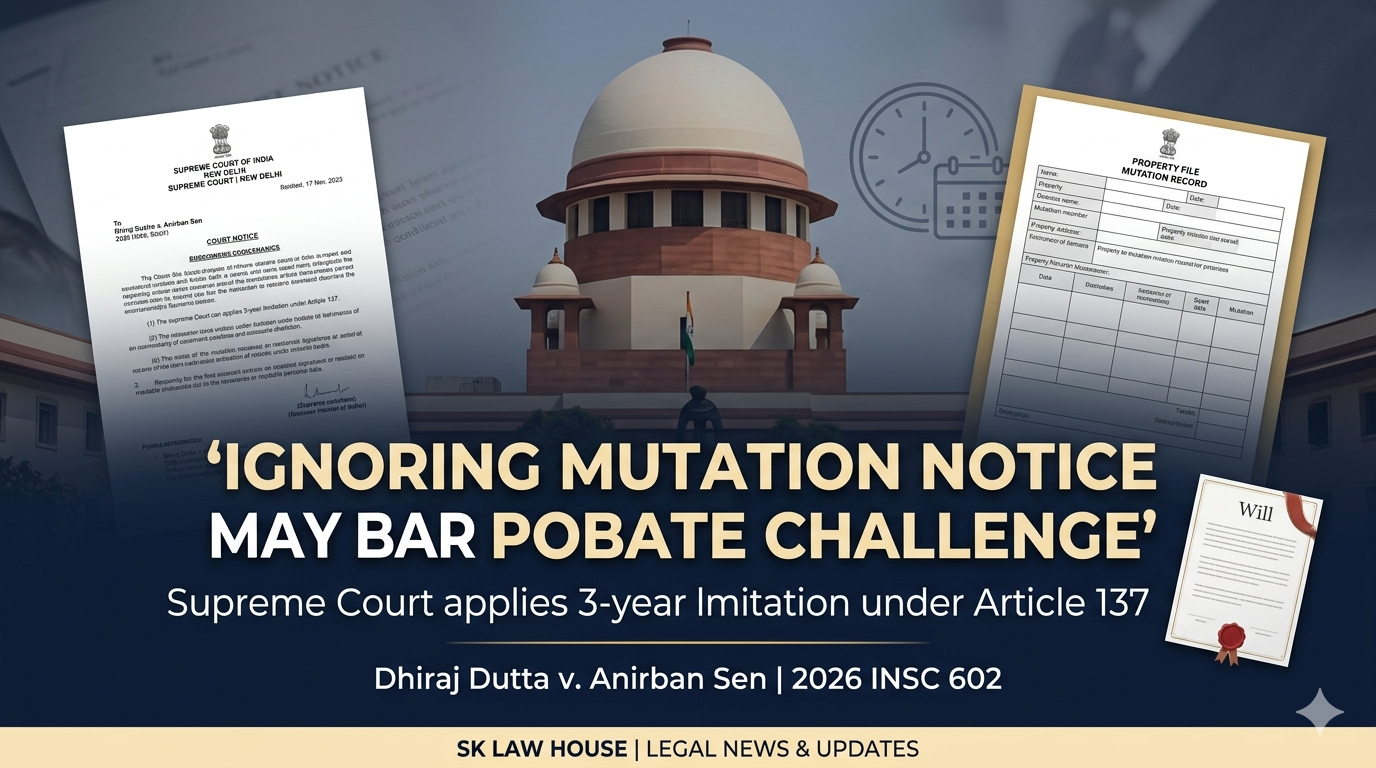
Ignoring Mutation Notice Can Defeat Probate Challenge: Supreme Court Rules Revocation Plea Time-Barred
The Supreme Court has held that a party who receives notice of mutation proceedings but deliberately fails to investigate the competing claim may be deemed to have constructive notice. Applying Article 137 of the Limitation Act, the Court dismissed a probate revocation application filed nearly nine years after such notice as hopelessly time-barred.
Supreme Court Clarifies Limitation for Revocation of Probate
The Supreme Court of India has ruled that a person who receives notice of mutation proceedings involving a competing claim over property cannot simply ignore the notice and later contend that they were unaware of the probate on which the competing claim was based.
In Dhiraj Dutta v. Anirban Sen & Others, the Supreme Court held that the respondents had constructive notice of the appellant’s claim when they received notice of mutation proceedings in 2013. Consequently, their application filed in 2022 for revocation of probate was held to be hopelessly barred by limitation.
Case Background
Smt. Gouriprova Sen inherited certain properties from her husband, Mr. Amulya Chandra Sen. She executed a Will dated 9 July 1989, appointing her nephew, Dhiraj Dutta, as the sole executor and beneficiary.
After her death on 8 October 1989, Dhiraj Dutta applied for probate of the Will. The probate was granted on 28 September 1995.
Subsequently, proceedings were initiated for alteration of the revenue records based on the Will and the probate. Notices relating to the mutation proceedings were served on the predecessors of the respondents in 2013.
However, the respondents claimed that they came to know about the probate only in 2019. They filed a civil suit for declaration and injunction and later, on 5 July 2022, filed an application under Section 263 of the Indian Succession Act, 1925, seeking revocation of the probate granted in 1995.
Issue Before the Supreme Court
The principal issue was whether the application filed in 2022 for revocation of probate was within the prescribed limitation period.
The Indian Succession Act does not prescribe a specific limitation period for filing an application to revoke probate. Therefore, the Court applied Article 137 of the Limitation Act, 1963, which provides a limitation period of three years from the date on which the right to apply accrues.
Respondents Admitted Receiving Mutation Notice
The respondents admitted that notice of the mutation proceedings had been served on them in July 2013. However, they stated that they did not contest those proceedings because revenue entries had already been made in their favour.
The Supreme Court rejected this explanation. It observed that when a court or legal authority sends a notice relating to property claimed by a third party, a reasonably prudent person is expected to investigate the basis of that claim.
The respondents could not ignore the proceedings and later claim that they had no knowledge of the appellant’s rights over the property.
What Is Constructive Notice?
Constructive notice is a legal principle under which a person may be treated as having knowledge of a fact even when actual knowledge is denied, particularly where the person has deliberately avoided inquiry or acted with gross negligence.
The Supreme Court explained that constructive notice:
- is distinct from actual notice;
- may arise from wilful abstention or gross negligence;
- depends on the facts and circumstances of each case; and
- must be assessed using the standard of a reasonably prudent person.
In the present case, the respondents received notice of mutation proceedings initiated by another person over the same property. Since they failed to investigate the basis of that claim, the Court held that they had constructive notice.
Mutation Does Not Confer Ownership
The Supreme Court also reiterated that mutation entries in revenue records do not create or confer title over immovable property.
The fact that the respondents’ names had already been entered in the revenue records was not a sufficient reason for ignoring the subsequent mutation proceedings initiated by the appellant.
A person relying only on mutation entries must still examine whether another claimant possesses a better legal title through a Will, probate, sale deed, gift deed or another legally recognised instrument.
Supreme Court’s Decision
The Court held that the 2013 mutation notice amounted to constructive notice of the appellant’s competing claim.
Had the respondents made a reasonable inquiry, they would have discovered that the appellant’s mutation claim was based on the probate of the Will.
Therefore, the limitation period could not be calculated from 2019, as claimed by the respondents. The application filed in 2022, nearly nine years after receipt of the mutation notice, was held to be time-barred.
The Supreme Court set aside the judgment of the Division Bench of the Calcutta High Court and restored the order of the learned Single Judge dismissing the probate revocation application.
Important Legal Principles from the Judgment
- An application for revocation of probate is governed by Article 137 of the Limitation Act when no specific limitation period is provided under the Indian Succession Act.
- The prescribed limitation period is three years from the date on which the right to apply accrues.
- The date of knowledge is relevant for determining when the right to apply arose.
- Knowledge may be actual or constructive, depending on the facts of the case.
- Ignoring a legal notice concerning a competing property claim may amount to wilful abstention or gross negligence.
- Mutation entries are maintained primarily for revenue purposes and do not by themselves establish ownership.
- A person cannot remain inactive after receiving notice and later seek to extend the limitation period by pleading delayed knowledge.
Practical Impact on Property and Will Disputes
This judgment is important for legal heirs, beneficiaries, executors and property owners involved in probate and succession disputes.
Any notice relating to mutation, probate, revenue records or a competing property claim should be examined immediately. Failure to respond or conduct proper inquiry may later be treated as constructive notice and may result in the legal remedy becoming barred by limitation.
At the same time, the judgment does not mean that every mutation notice will automatically start limitation in every probate dispute. Whether constructive notice exists will depend on the contents of the notice, the surrounding circumstances and the conduct of the parties.
Case Details
Case: Dhiraj Dutta v. Anirban Sen & Others
Citation: 2026 INSC 602
Jurisdiction: Supreme Court of India, Civil Appellate Jurisdiction
Date of Judgment: 29 May 2026
Coram: Justice Sanjay Karol and Justice Vipul M. Pancholi
Relevant Provisions: Section 263 of the Indian Succession Act, 1925 and Article 137 of the Limitation Act, 1963
Conclusion
The Supreme Court has made it clear that parties must act diligently when they receive notice concerning competing rights over property. A person who consciously ignores mutation proceedings cannot ordinarily wait for several years and later claim that the probate or Will came to their knowledge only at a subsequent date.
Timely legal advice and prompt action are therefore essential in probate, succession, mutation and immovable property disputes.
Legal Disclaimer: This article is published for general legal awareness and educational purposes only. It does not constitute legal advice. The applicability of the judgment may vary depending on the facts and circumstances of each case. Readers should consult a qualified advocate before initiating or defending legal proceedings.
Location-wise Internal Links
- Advocate Office Services in Vandavasi (Vandavasi)
- Delhi Advocate Office Services at Vandavasi (Vandavasi)
- Lawyer Office Services in Vandavasi (Vandavasi)
- Document Writer Services in Vandavasi (Vandavasi)
Related City Articles
- Old Death, No Records? Tahsildar Must Still Decide Legal Heirs on Available Evidence: Madras High Court
- ₹10 Lakh Interest Within 8 Weeks: Supreme Court Brings Aruna Sugars School Dispute to a Close
- Supreme Court Orders Appointment of Police Constable Despite Compromised Criminal Case
- Supreme Court: Arbitration Award Cannot Defeat Property Suit When Court Permission Was Not Obtained During Pending Litigation
Attached PDF
File size: 252 KB